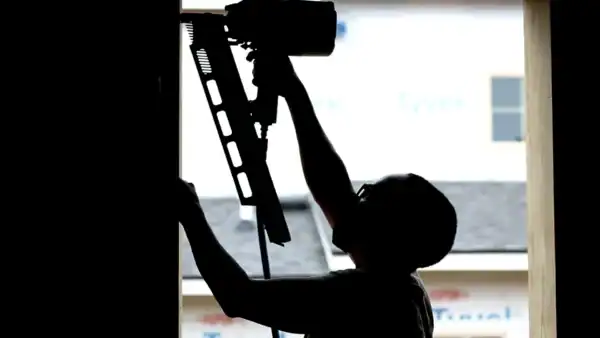
On a hot summer day in Baltimore, a Black woman with a shaved head and muscular, tattooed arms, builds a window frame in an old brick row house. She moves deftly from the opening in the bricks to her power saw, cutting and fitting a board until she can wedge it tightly into place. By her ease with the tools and the grace of her movements, you can tell she has been doing this a long time.
This is Shelley Halstead, founder of Black Women Build – Baltimore. A long-time carpenter, Shelley moved to Baltimore in 2015 and was stunned by the city’s dilapidated housing. “I was like, ‘Oh my God, there’s so much potential,’” she recalls. “As a builder, you’re like, ‘I can fix that.’” Saving Etting Street, a feature documentary by Dena Fisher and Amy Scott, tells the story of her fight to do that.
The film follows Shelley as she trains a group of three young, Black women in construction skills by rehabbing vacant and abandoned houses in West Baltimore’s Upton/Druid Heights neighborhood. If they complete the program, the women will be eligible to buy the houses. The mission is to transform a distressed block on Etting Street into a community of Black women homeowners, helping build generational wealth and stability in a neighborhood plagued by poverty, crime, and neglect.
As the film begins, co-director Dena Fisher introduces us to the community where she lives, and where Shelley is building. Upton/Druid Heights was once a thriving Black community, home to Thurgood Marshall and Cab Calloway. Now, nearly a third of the houses are vacant and Dena’s sons are growing up with the trauma of regular gunfire. Dena’s voice can be heard from behind the camera and in voiceover throughout the film, guiding viewers through the story of change and conflict in her community.
We meet the young women Shelly is training to build. Shandria (Shan), is a pharmacy technician who lives at home with her hardworking mom. She hopes to follow her sister Quanshay, the first participant in Black Women Build – Baltimore, in becoming a homeowner. Chanelle works nights at an Amazon warehouse. She grew up in a troubled family and sees homeownership as a path to independence. Bryanna comes from a working-class Baltimore family and works part-time at a restaurant. Round-faced and prone to bursting into giggles, she quickly emerges as a leader in the group.
As the transformation of the block gets underway, we pull back to learn more about how these houses ended up vacant for decades. In 1910, the nation’s first racial zoning ordinance was written just blocks away in a nearby church, enforcing the segregation that in many ways persists today. An animation illustrates where the neighborhood lies on the original 1937 redlining map, created by the federal government to steer subsidized loans away from Black neighborhoods.
On the job site, tensions emerge in the group. Chanelle often shows up late — or not at all. As Shelley teaches them, we see flashes of impatience. She’s worked as a carpenter for 25 years and finds it’s harder to teach these skills than she expected. When Shan struggles to screw decking into place Shelley wonders aloud if she’s “cross-eyed.” Shan walks away hurt. Tonika Garibaldi, BWBB’s program manager, is often the intermediary, smoothing out conflict and working hard to keep everyone friendly and on track.
The women meet their future neighbor, Poinsetta McKnight, who’s lived on the block since the 1940s. Before Shelley and Black Women Build arrived, McKnight was the last homeowner remaining on the block, writing desperate letters to city officials in fear that they would tear it down. Ms. Poinsetta, as everyone calls her, wakes up early every morning to patrol the block, picking up trash and keeping the drug dealers in check. Dena describes Ms. Poinsetta as one of the “original Black women builders” who’ve held down the community for generations. Shelley says it was Ms. Poinsetta’s well-tended garden – a sign of life in a sea of neglect – that made her want to save this block.
As the physical work nears completion, the real hurdle becomes financial. Low pay, student debt, and credit barriers make securing a mortgage a steep hill for some of the trainees. When a suspicious fire breaks out at one of her other projects, Shelley is forced to confront just how hard it is to reverse decades of disinvestment—and what it truly takes to build a community.