Fifteen years ago, I lost one of my closest friends. Her name was Yo (Yolanda Shae). When we
met, I was twenty‑four and she was seventy‑three. It was a love‑at‑first‑sight kind of friendship.
Yo was many things to many people: a great‑grandmother, a career weed dealer, an intellectual
thought partner, a psychic, a hostess, and—on occasion—a tyrant. To me, she was a seer of
truth and an enduring inspiration.
I was not ready to lose her. A year before her death in 2013, I began filming our visits, capturing
her memories and anecdotes. She lived on her own terms, defying post‑war conventions of
femininity, motherhood, and sexuality. These epic tales spanned eight decades and three
continents. Her stories that focused on pivotal moments of transformation, became the blueprint
for this film.
For a few years after Yo died, I didn’t want to look at the vérité footage. I couldn’t see what I
had, I was simply haunted by what was absent. I had thought the footage would console me but
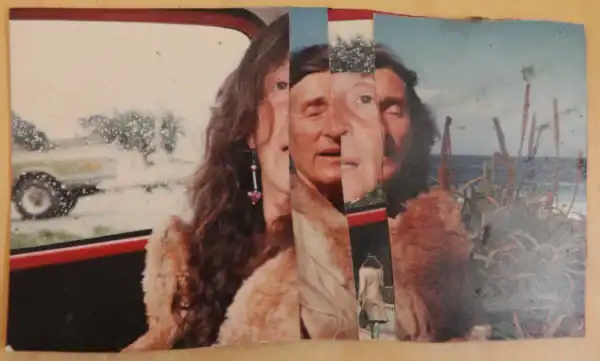
it was the opposite. I was more drawn to the tactile remains of her life: an old sweater, the scent
of her perfume, scraps of fabric, and stacks of photographs.
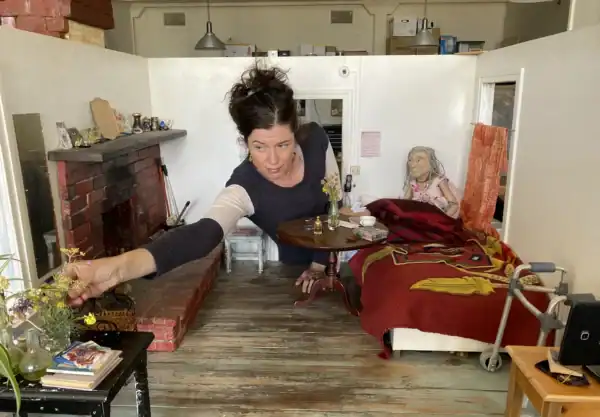
What started as an exploration of her belongings ultimately became a ten‑year obsession: the
construction of a detailed 1/3‑scale replica of Yo’s house and everything inside it including a
20in puppet of Yo. This act of building it was cathartic and brought me back to the footage.
The art studio became a ritual place where our relationship could continue to evolve. The house
became a spiritual touchstone, a portal between the past and present, and between my lived
experience and what lies beyond.
Like my own experience of grief, the making of this film was not linear or predictable.